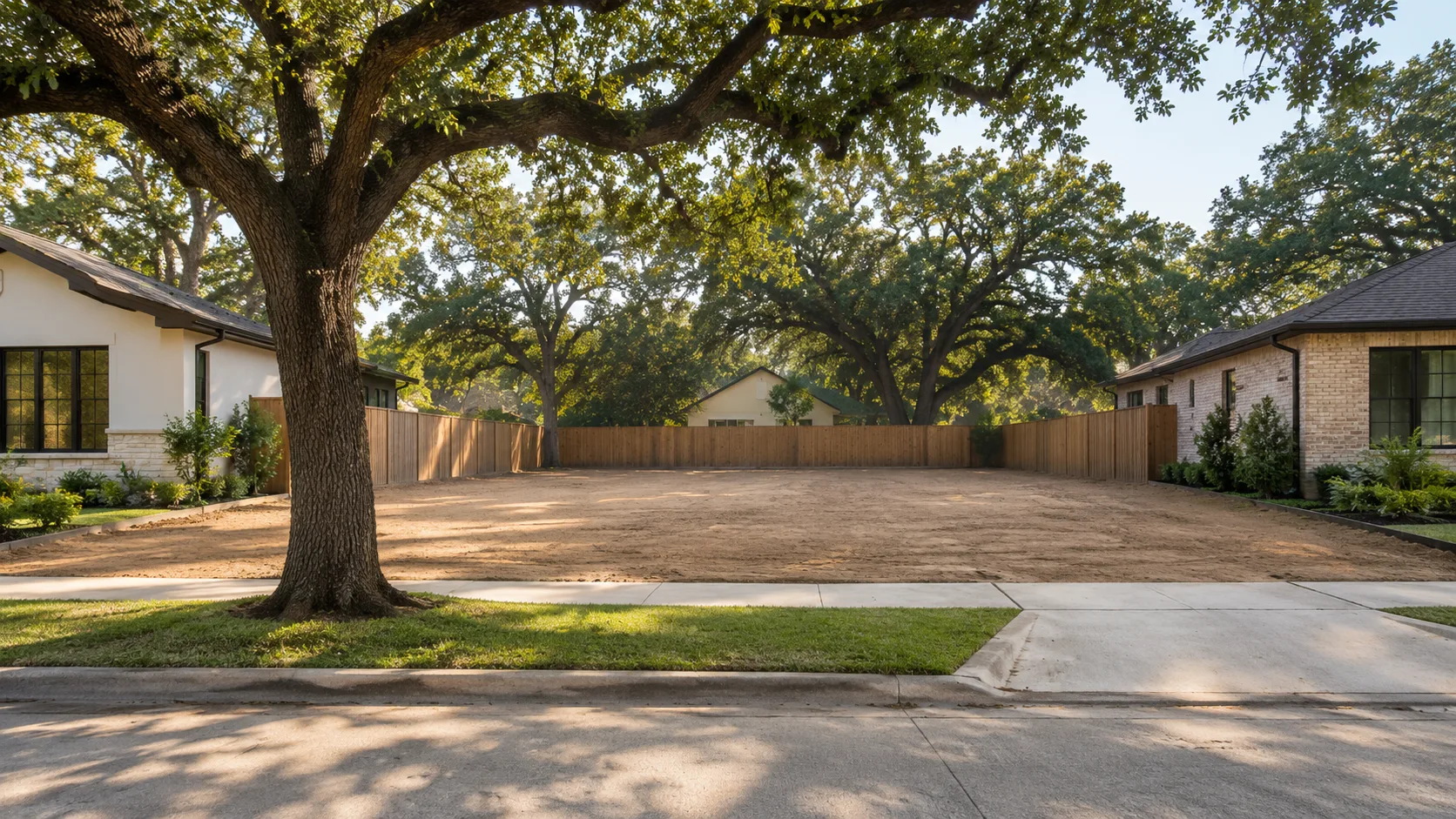
In the City of Houston, a demolition permit cannot be requested until a registered master plumber has disconnected every sewer and water line to the building and the Plumbing Inspection Section has inspected and finaled that disconnect. Only then does the Permits Office issue a demolition permit, which for a house costs $94.00 for the first storey, $47.00 for each additional storey and a $33.56 admin fee, and which the City says it processes in 1 business day.
The part that surprises people is the other end. The final demolition inspection has to pass before the City will sell you a permit for the new house. A teardown is not finished when the machine leaves; it is finished when an inspector signs off a clean, level lot.
This guide follows the City's own paper: the Residential Demolition Permit page and the Building Demolition Guideline, Form CE-1075, revised January 2026. It covers the City of Houston only. A lot in an incorporated suburb or unincorporated Harris County sits under a different office, and which authority permits your lot comes first.
The order that catches people out
A demolition permit looks like the simplest permit in the building department. It has no plan review, and the City lists the residential permit as valid for 180 days with no renewal needed. The trap is that the demolition permit is not the first permit. It is the third thing in a chain, and the chain runs in a fixed order.
The City of Houston demolition sequence, in order
Two of those steps are done by someone other than you. A registered master plumber has to apply for and buy the plumbing permit; the guideline says so in as many words, and the demolition application is checked against the City's records. The Customer Service Representative reviewing your email looks up the address, confirms the sewer disconnect has been inspected and finaled, and only then replies with a sales order. If the disconnect is not on file, the application waits.
That has a planning consequence. Whoever is scheduling the teardown needs the plumber booked first, and the plumber's inspection has its own queue. We cannot give you a number of days for it because neither document states one. What the documents do state is the 1 business day the Permits Office takes once everything is in.
What the City says the permit covers
The guideline is blunt about scope, and three of its lines are worth reading closely.
The permit requires removal of everything. A demolition permit "requires the removal of all construction materials from the jobsite including the building slab," with certain exceptions the Building Official can approve. The site "must be left free of debris and be level within the boundaries of the property." For a teardown buyer this is the baseline: the lot you hand to the foundation contractor is bare, level ground. That is also worth knowing when you are weighing impervious area, because our piece on when a house needs detention notes that the documents we read do not say how a demolished slab is counted on a rebuild, and the answer is a question for the City's stormwater section.
It does not reach into the street. The guideline says the permit "does not authorize work located in the right-of-way such as sidewalks, driveways, curbs, or accessibility ramps," and its notes add: do not remove sidewalks, driveways, curbs, ramps or trees from within the street right-of-way. The line between your lot and the City's strip is a survey question, and we cover where it falls in right-of-way versus property line. A machine operator who takes out the driveway apron on the way past has done work the permit never allowed.
One permit per structure. "A separate permit is required for each separate building or structure being removed in whole or in part." A house, a detached garage and a garage apartment are three structures, not one job. Partial demolition counts too, which matters when a remodel quietly turns into a gut.
The City's page adds that a swimming pool needs a separate Fill and Grade permit, and it lists a Swimming Pool Demolition Guideline, CE-1090. We have not read that document, so we say only that a pool is its own piece of paper, and that a pool on a teardown lot should be known about before the schedule is set.
What the City charges
The fees are small, and they are the only part of a teardown budget that is fixed.
| Item | City fee |
|---|---|
| Demolition permit, 1st storey | $94.00 |
| Each additional storey | $47.00 |
| Admin fee | $33.56 |
| Sewer disconnect plumbing permit, minimum, with admin | $131.12 ($97.56 + $33.56) |
Those figures come from the City's residential demolition page and from CE-1075, and they agree. The guideline's fee table is a little untidy: it also shows a $47.00 line beside the sewer disconnect that we read as an addition to the minimum, but we cannot be sure, so confirm it with the Permits Office. Here is our own arithmetic, with an invented house, to show the scale.
City of Houston permit fees to demolish one house, by storeys, including the $33.56 admin fee
Add the sewer disconnect permit at its $131.12 minimum and the City's paper for a 2-storey house comes to $305.68. That total leaves out the plumber's own charge for the work, the contractor's price for the demolition itself, hauling, and any asbestos work. Those are real money and we do not quote them here. Our guide to renovate, add on or rebuild already makes the point that the cost of building new leaves out demolition, and that the real figure varies by lot. A City fee of a few hundred dollars is a rounding error next to those.
Asbestos: what the City asks, and what it does not say
The residential permit page asks you to send an asbestos survey "if applicable." The word that matters is applicable, and the City's Asbestos Survey Guideline, Form CE-1258, revised June 9, 2022, says what it means.
The guideline implements Senate Bill 509, which requires cities to verify that an asbestos survey has been done before issuing renovation or demolition permits for public or commercial buildings. It defines that as "non-residential buildings and apartment complexes larger than a four-plex." A single-family house is outside that definition, so on the City's reading a house demolition permit does not hold up for want of a survey. The commercial demolition side is stricter: the guideline demands proof of an asbestos inspection from a state-certified third-party inspector.
What the guideline does not say is that a single-family house is free of asbestos rules. It speaks only to what the City checks before it sells a permit. The same document cites the Texas Asbestos Health Protection Rules and the federal NESHAP in its model letter, and it lists the Texas Department of State Health Services at 1-800-572-5548 or 512-834-6600 for questions. We read the City's pages, not the state rules, so we cannot tell you what a homeowner or contractor owes the state on a 1960s house with old flooring and ductwork. For an older house, ask the state, and ask the demolition contractor what they test for before they start. For an older house the question is worth asking before the machine arrives, not after.
Before the permit: the things the City does not ask for
The City's permit is silent on several questions that decide whether a teardown goes smoothly. Check these before the sewer disconnect is booked.
Deed restrictions. The demolition permit does not ask whether your subdivision's restrictions say anything about removing or replacing a house. They are enforced by the neighbours and the civic association, not by the building department, and our guide to finding and reading deed restrictions explains where to get them. Read them before you demolish something you cannot put back.
Historic districts. Parts of the Heights are inside City-designated historic districts, where demolition has its own approval in addition to the building permit. We cover that in building in the Heights. The City's demolition page and guideline do not mention it, which is exactly why it gets missed.
What the old house is worth to the new plan. An older house may sit closer to a line than today's rules allow, and whether that position survives a demolition depends on the specific code. Do not tear down until you have drawn the new house on the survey and know the envelope it fits in, because the old slab is no guide to it. The surveyor's work is covered in what a survey shows that an appraisal does not.
What is under the slab. Nobody knows until it is out. Soil, old fill, abandoned lines and root balls surface after the slab goes. Whether the lot needs its own report is the question in when to order a soil report, and it is cheaper to ask it before the foundation design than after.
Official sources — City of Houston
- Houston Permitting Center
- Plan review
- Permit fee calculator
- Adopted codes
- Check plan review status
- Stormwater — Office of the City Engineer
- De minimis impact credit guideline (OCE-1006a)
- Storm detention requirements FAQ
- Design and construction standards (2026 IDM)
- Residential demolition permit
- Building demolition guideline (CE-1075) PDF
- Asbestos survey guideline (CE-1258) PDF
- Floodplain Management Office
- Common plan-review rejections (floodplain comments)
Where demolition sits in the project
The permit does not run in parallel with design. It has to be finished, inspected and signed before the new permit can be sold. But it does not have to wait for the design to be finished either, and that is the lever. Our guide to what happens during plan review notes that early demolition permits are separate applications that do not shorten the main review.
That means a sensible order for a teardown purchase is: survey and deed restrictions first, then design far enough to know the new house fits the envelope, then the plumber and the demolition permit scheduled so the lot is cleared and inspected while the permit set is in review. The goal is that the final demolition inspection is already on file when the new permit is ready to be sold. If it is not, the lot waits on an inspector while the design team and the builder wait on the lot.
The work behind this, from first drawing to the permit, is the process we run on our new custom homes projects, and the demolition permit is the one step on the list where nobody sends us a plan to review. It is purely sequence.
For a second view of the lot you are about to buy, the Modern Acre Studio article what to look for in a lot before you buy it covers the checks that come before any of this, and the same firm's piece on grading and drainage on Houston clay lots picks up from the level, bare lot the demolition inspection leaves you with.
What we could not confirm
The City publishes no time estimate for the plumber's disconnect or for the demolition inspection, and none of its pages say how long the inspection queue runs. The residential demolition page carries no date, and CE-1075 is dated January 2026; fees and forms change. We did not read the swimming pool guideline, the dangerous-building demolition process, or the state asbestos rules. And everything here is the City of Houston. Do not carry any of it to Sugar Land, Bellaire or West University Place.
Frequently asked questions
Do I need a demolition permit in the City of Houston?
Yes. The City's residential page says a demolition permit is required "for the demolition of any residential structure or building within the City of Houston," and the guideline extends that to any structure, commercial or residential. Each building is its own permit.
What comes before a demolition permit?
A registered master plumber has to buy a plumbing permit and disconnect all sewer and water supply lines. The Plumbing Inspection Section has to inspect and final that work before you can request the demolition permit. If the structure has no plumbing to disconnect, the guideline says to get approval from the Plumbing Inspection Section first.
How much does a house demolition permit cost?
The City charges $94.00 for the first storey, $47.00 for each additional storey and a $33.56 admin fee. So a 1-storey house is $127.56 and a 2-storey house is $174.56 on the City's figures. The sewer disconnect permit is a separate $131.12 minimum, and the plumber and demolition contractor charge on top. Confirm current fees with the Permits Office.
Can I leave the slab in place?
The guideline requires removal of all construction materials including the building slab, with exceptions "if approved by the Building Official." Plan on the slab coming out, and ask in writing if you want it kept.
Do I need an asbestos survey to demolish a house?
The City's guideline requires one for public or commercial buildings, defined as non-residential buildings and apartment complexes larger than a four-plex. Its residential permit page asks for one only "if applicable." That is what the City checks. It is not a statement about state or federal asbestos rules, which the Texas Department of State Health Services can answer.
Can I start building before the demolition inspection?
No. The guideline states that all demolition permits must have final inspection approval before a new construction permit can be sold.
What to do first
Before you book anyone, get the survey and the recorded deed restrictions for the lot and draw the new house on the survey. Then book the master plumber, because every other step waits on the sewer disconnect. If you want the envelope, the sequence and the permit timing checked against your lot before you commit to the teardown, start a consultation and we will go through it with the survey in hand.